Funny Games Significance of the Rewind
There are iii participants in Micheal Haneke's disturbing satire on American habitation invasion movies. The family that is being held hostage, the intruders, and the audience themselves. Funny Games (1997) partakes these three entities, indulging us in sadistic, sickening turns. Information technology uses the narrative of a typical slasher film set within the confines of a dwelling and makes fun of the fix expectations and clichés in the audience's heed. In doing so, the games are played within and exterior the reality of the film itself. Making the experience truly original.
Sans the occasional flash and 4th wall break, there'south no way a general audience can perceive this pervasive reworking of a typical 'family unit-trapped-in-large-house-as-psychopaths-circle-around trope; to be something that can't happen in real life. The reason why most habitation invasion movies manage to creep out the audiences is the fact that these scenarios can pretty much happen with anyone, anywhere.
This is the reason why Haneke wanted to turn his critical lens to the moral compass that these home invasion movies fail to embrace. In trying to lure the audience into a scare-fest, they occasionally go along to normalize and glorify violence. While Haneke's Funny Games (1997) also glorifies it, there'southward no celebratory bound in the stop. While most movies of the sub-genre end with one of the victims finding the courage to confront the intruders, Haneke shows us the flip side of that state of affairs.
Here'south how Funny Games (1997) subverts expectation:
The Opening sequence of Funny Games:
To really sympathize how the director plays with the audience'southward expectations, let's rewind to the very start of the picture. A wealthy family of iii – George, married woman Anna, and son Georgie are in their machine happily driving to their vacation home. A huge boat is seen hooked to the vehicle and the couple is playing a guessing game with each other. The two take turns to play a classical music piece on the car's player as the other ane guesses the artist. Their son is perched in the backseat accompanied by the family dog Rolfi.
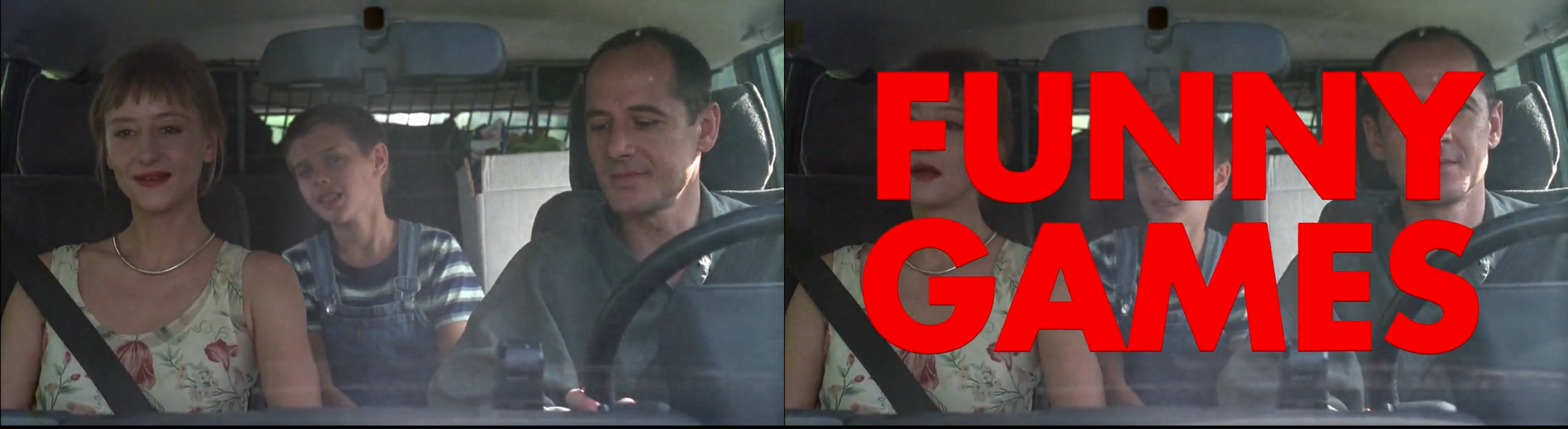
The first time Haneke disrupts the proceedings is a warning about the dread right away. A heavy metal sequence plays over the soothing classical slice as if alarm the audiences for the commencement time. To put it accurately, Haneke wants the audience to leave the motion picture right away. The title of the film appears in big red letters, further amplifying the annotation of a wave of unnerving sequences waiting for you. Now, don't get me wrong. Of course, a filmmaker makes a film that you wish to see and they desire you to see. However, Haneke is basically critiquing the fact that the perversion present in the mind of the audience can surpass that of the ones seen on screen. In a way, we desire to see dreadful, sadistic things and then that nosotros tin self-congratulate ourselves that our lives are better.
Haneke is more interested in a nihilistic sense of morality. His view of the world and the people in it comes from a standpoint that proves that people and their inhibitions tin be oftentimes misleading. For example, I equally an audience was amused and not disturbed by the literal insertion of a disruption in the musical cue. It speaks a lot most how I perceive a flick and any other piece of a cinematic oddity in general. In a fashion, the filmmaker is speaking direct to me. He is critiquing the way I programme to run across fiction playing out in forepart of me. If I programme to go out at this point in time, it shows that I might not exist the target audience and that I am affected by an unnerving gaze.
Subversion of the Home Invasion sub-genre:
Now at that place are a lot of instances where Funny Games subverts the Home invasion genre. I mean, it'southward congenital that way. The structure in itself is truly ambiguous. Withal, since we are going in chronologically, let's talk well-nigh the sequence later on the championship appears. The family is about to reach their vacation dwelling house when they witness that their neighbor is conversing with a couple of young boys. These will be the said intruders who thereby play sadistic games with the family. It's exactly where the director subverts the very kickoff trope. The idea of a surprise intrusion with masked people and their intentions is never put into context.
Haneke is readily perspiring not to trick y'all into believing that there is a sudden dreadful state of affairs at paw. In a way, he is directly making fun of the sadistic American home invasion films that play with these horrific tropes to put y'all in a country of complete dismay. The invasion happens with conclusive results. This is because the managing director is eager to warn the audience at every given instance.
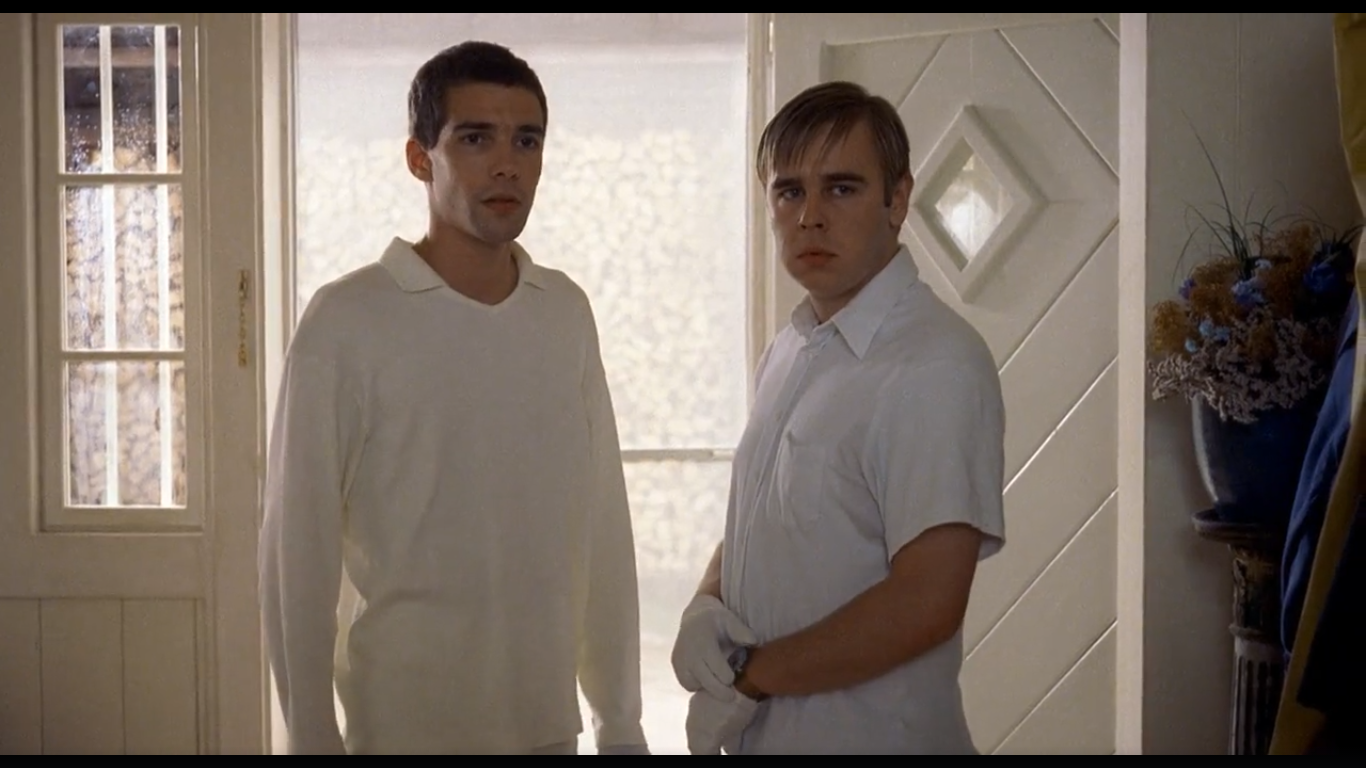
Next up. When Peter and Paul outset imposing themselves on the family, their low-primal stupid antiques don't seem threatening enough. While Paul seems like a skinny swain who Georg – the head of the family could easily wrestle out, Peter seems oblivious and clumsy. However, Peter'south clumsiness only results in the family unit's loss of connexion to the real earth. The borrowed eggs break and the family's phone gets destroyed – supposedly by accident.
The subversion hither is pretty low-brow since the ii invaders never seem like people who can really hold someone earnest. Yet, they eventually do because of their breakable forcefulness and stupor value.
Breaking the Fourth Wall:
Different most films that break the fourth wall to reveal themselves equally a metaphorical look at the human condition, Haneke's Funny Games takes its own sweet time before revealing its meta-narrative. This is an interesting mode to expect at how exactly does the director play with the audition expectation.
Most cine enthusiasts who are actually aware of meta cinema and how it is used every bit a tool to direct communicate with the audience – i.e bridging the gap between the screen and the conscience will see how Haneke uses it every bit another trigger to shock you lot. Hither, he doesn't communicate how the victims will somewhen fall casualty to the invaders, but he plays with your heed.
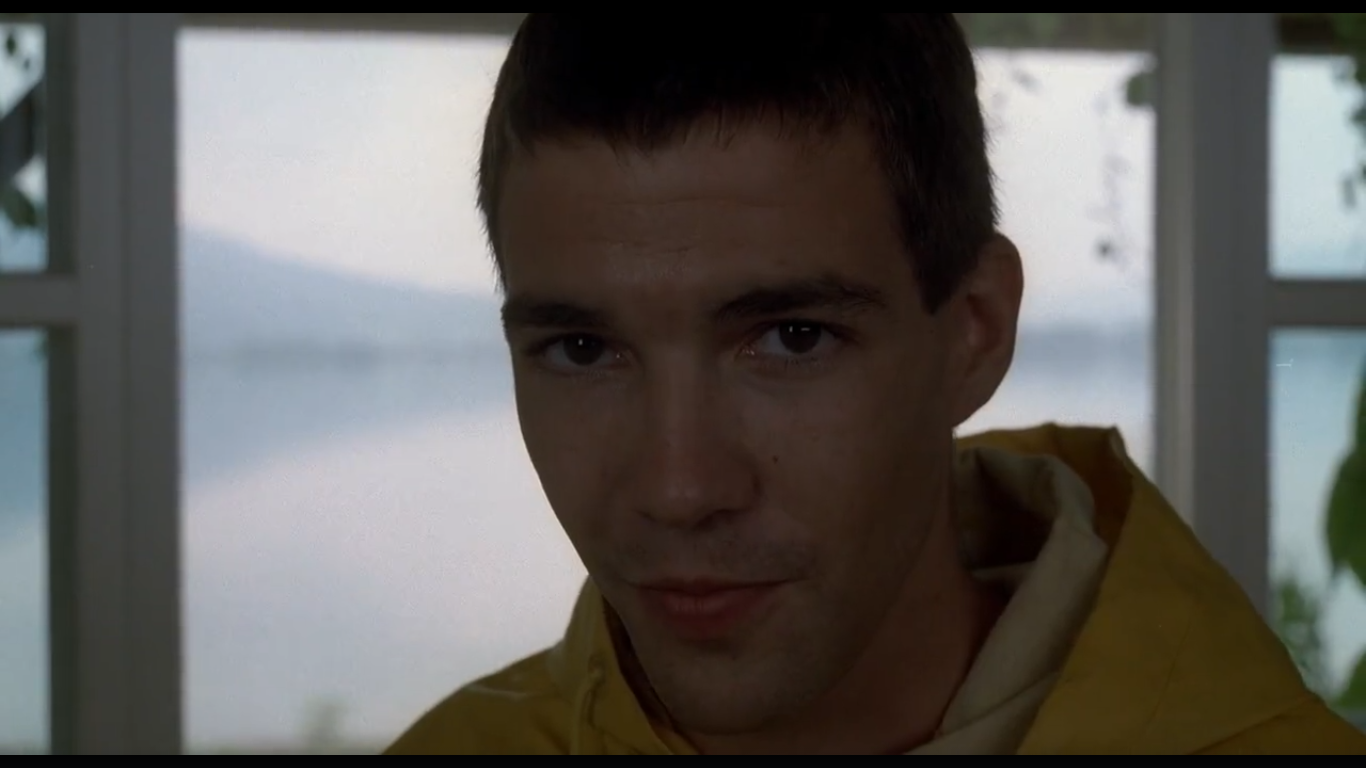
Only Paul (Arno Frisch) breaks the fourth wall. This means all other characters work equally victims and proprietors. The start time the quaternary wall is broken, Paul slyly winks at the camera. This sequence features the family's much-adored dog 'Rolfi' beingness denounced expressionless.
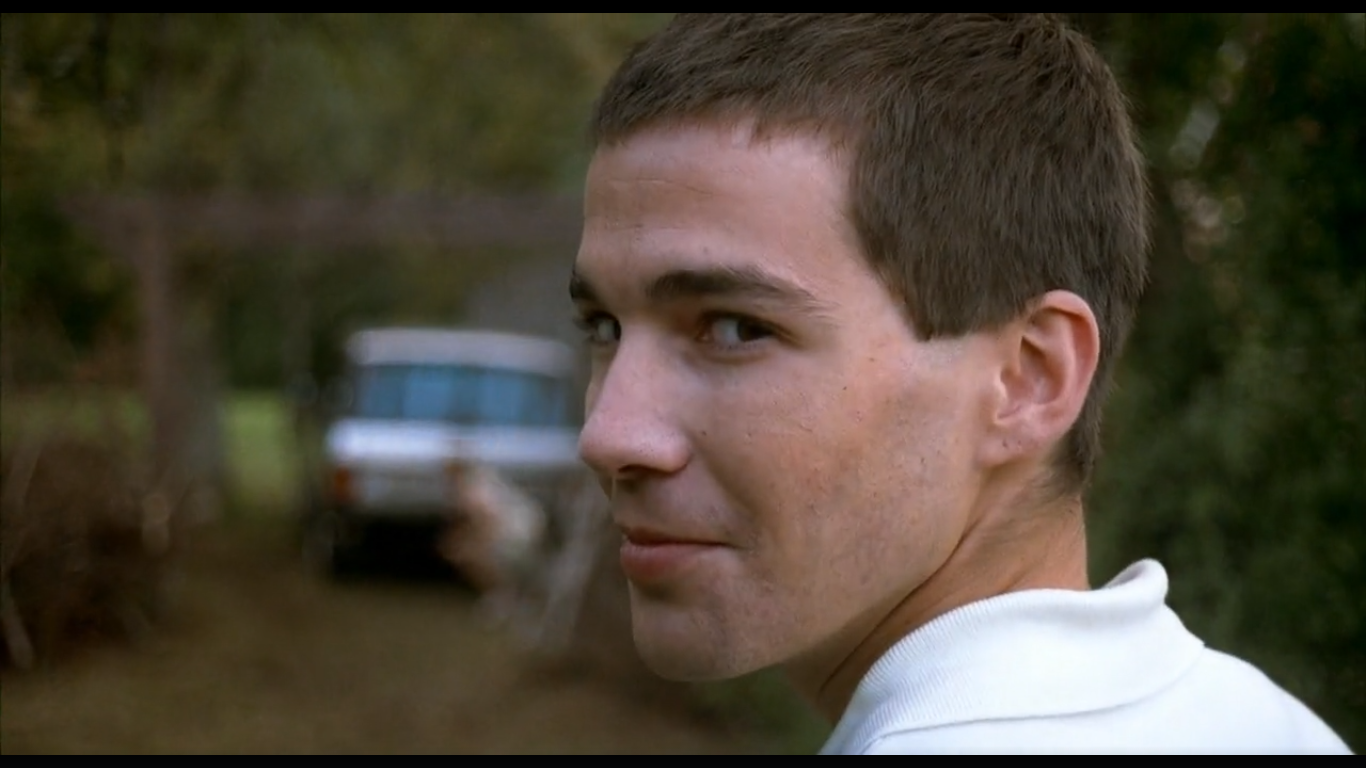
At present, when it comes to violence against animals, near home-invasion American counterparts either use them as a fashion for victim redemption or prove them escaping the treacherous human action. Some also bear witness their eventual fall off-screen. Which merely means that these directors imitation-sympathize with you for the sake of the redemptive arc that is coming towards the stop.
Then, when Haneke's graphic symbol winks at you, it implies that the audience should leave, and if they manage to stay; it shows that their simulated sympathy is actually pretty real. These meta intrusions actually uncover our hypocritical feelings of actually enjoying sadistic acts of violence. And so much then that we are even going to allow animal violence by normalizing it because information technology works within the realm of the motion-picture show itself.
Turning the conflict over its head:
The usual conflict in abode invasion movies arrives when, (a) one of the victims manages to flee or (b) when the invaders take some kind of personal vendetta within themselves; resulting in losing a grip on their victims. In Haneke's Funny Games both those plausible notions are presented to uncover a more macabre motive.
For instance, after Peter and Paul subject the family to sadistic situations, Georgie manages to feel to a nearby house. This is the exact narrative strand that serves as a kind of role-reversal in such films. The one who manages to flee will somewhen turn the hostage situation over the head and it will be the invaders who volition accept to suffer thereafter.
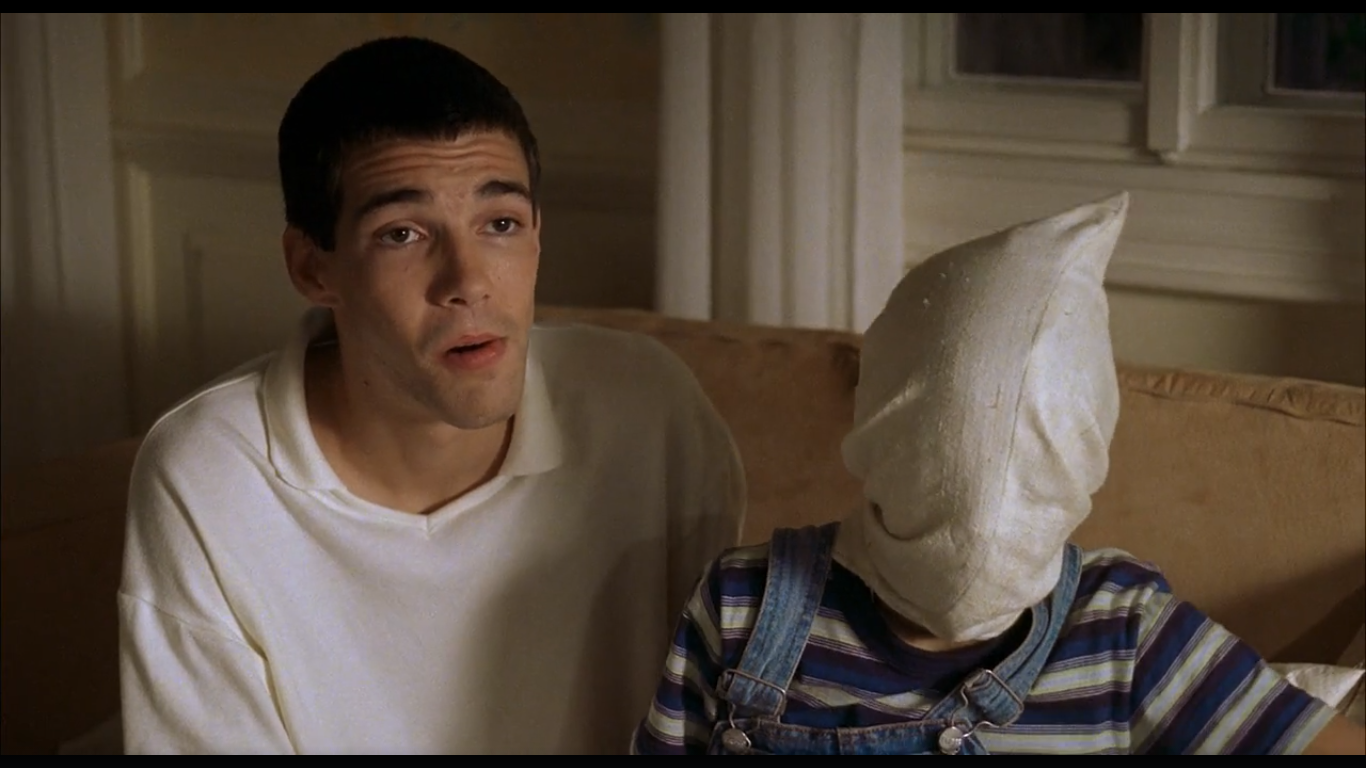
This cliche is more manipulative than most of the emotionally moving melodramas out there. I mean, the filmmakers are literally subjecting you lot to sadistic acts then as to declare you the winner in the finish. In reality, these kinds of situations would never plough upward the way they really do in films.
Haneke is playing on that clue. While Georgie manages to flee, he is soon captured and is brutally murdered. While this may seem like an farthermost step taken from the manager, it goes to bear witness that not all things end on a happy annotation. That things, don't fix themselves, and evil can actually win over the good.
More than so, he slaps the audience on the face when the captives overpower the invaders. In a sly throwback to his own film Benny's Video (1992), Haneke rewinds the reality of the film and resets the game in favor of the invaders.
Letting the Chekov'southward Gun slip away:
To understand what Chekov'due south Gun actually stands for in the terms of its cinematic memory, you must look at what the renowned writer says about a burglarize hanging on the wall in the outset chapter of a book. To reiterate it, allow'due south look at a very common example. Remember the Rita Hayworth poster in The Shawshank Redemption? The one that was given to Andy past Ray and seemed like a dainty fiddling gesture in the offset half of the film? Nosotros all know how significant that poster actually became when the redemption finally happened.
Coming back, habitation invasion movies are full of such Chekov'south Gun. Nosotros are introduced to a certain element that eventually becomes instrumental in how things plough around for the victims. Similar to this, Haneke'southward Chekov'south Gun is actually a pocketknife in Funny Games. In the start tertiary of the film, we see Georg fixing his boat upward on the dock. He unintentionally drops one of his knives in the boat itself.
At present, Haneke makes sure that he focuses on this knife being casually dropped in the boat for when Paul and Peter take Anna for a ride in the aforementioned gunkhole in the third act of the pic the Chekov'due south Gun reappears but does not serve its purpose in its traditional sense. That is, Anna is not able to use the knife to abscond herself from the clutches of the captures.
Thus, there is no happy ending here. In fact, the invaders reset the narrative in a complete circle where we see them selecting some other house that was cleverly foreshadowed to us by the director somewhere in the film itself. When the film ends with Paul breaking the fourth wall gleefully grinning at the camera, it merely spats at the audition and their sadistic intuitions.
Funny Games is not but the cleverest genre picture show that I have seen in a while but besides ane that questions the very material of humane tendencies and to what extent can it really digest violence. Haneke's film becomes more than relevant because nosotros, the contemporary gild that consumes murders and death on a regular basis over social media and other channels, are at present actually stripped abroad of nearly of the things that nosotros experience. Information technology just goes to evidence how fine art can mean different things at dissimilar stages of life.
Funny Game (1997) Links – IMDb, Rotten Tomatoes
Source: https://www.highonfilms.com/funny-games-1997-explained/
0 Response to "Funny Games Significance of the Rewind"
Post a Comment